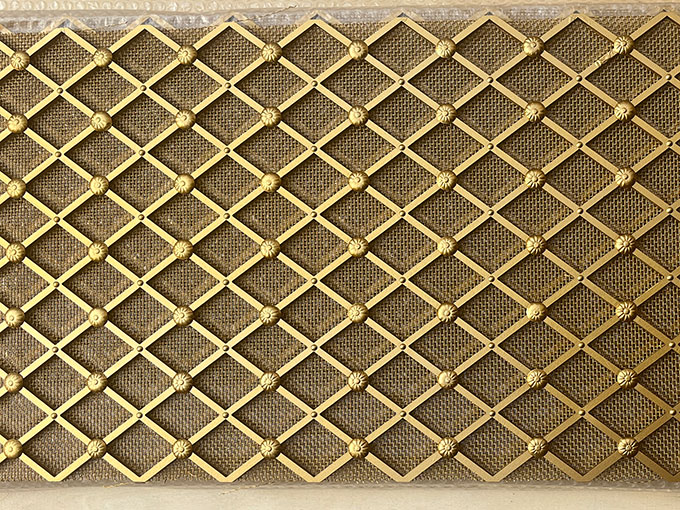
Metal coil drapery brings the flowing, fabric-like qualities of traditional curtains to the world of architectural metal. This innovative material has redefined how designers think about space division, window treatment, and decorative screening in both commercial and residential settings.
In this comprehensive guide, we explore what makes Metal Coil Drapery unique, how it is manufactured, its key benefits, and the wide range of applications where it delivers outstanding performance.
Metal coil drapery is produced by tightly coiling flat wire into a continuous spiral, then linking adjacent spirals to form a flexible mesh sheet. The resulting material drapes like fabric while maintaining the durability and reflective qualities of metal. Available in widths up to 5 meters and made from aluminum, stainless steel, or copper in various colors and finishes, coil drapery can be installed on track systems for operable curtains or fixed as permanent decorative panels.
Each manufacturing method and material choice offers distinct advantages in terms of structural strength, filtration precision, visual appearance, and adaptability to different environments. Understanding these differences is key to selecting the right product for your specific application.
The market offers many similar-looking products, yet performance differences are significant. The characteristics below are where Metal Coil Drapery consistently outperforms generic alternatives and lower-grade substitutes.
Every batch of our Metal Coil Drapery is accompanied by a mill certificate confirming alloy composition. Lower-cost alternatives often substitute 201 or 430 grade for advertised 304 or 316 — leading to rust within months. Insist on documentation.
For woven Metal Coil Drapery, the metal structure has no welded intersections — strands are continuous. This gives it markedly better fatigue resistance and impact tolerance than welded mesh, especially under cyclic load.
Unlike perforated or stamped sheets that can leave burrs and residual stress, Metal Coil Drapery weaves or expansions are clean and consistent. This matters in filtration, where burrs contaminate flow, and in architecture, where smooth surfaces are touched.
Sintered variants of Metal Coil Drapery hold their pore structure under differential pressure, while non-sintered mesh can deform and shift openings. Critical filtration processes depend on this stability.
Each production lot carries a batch code linking back to raw material certificates, production parameters, and inspection records. In the rare event of a quality issue, traceability allows targeted investigation.
Painted, coated, and synthetic alternatives fade, chalk, and discolorize over time. Metal Coil Drapery retains its metallic appearance for decades with routine cleaning — a key reason it dominates premium architectural projects.
Operable room dividers and partition curtains, window treatment and solar shading, retail storefront and doorway curtains, hospitality space dividers and feature walls, exhibition and stage backdrop curtains, ceiling drapery and suspended visual elements, staircase and atrium screening, outdoor patio and pergola shading.
The versatility of Metal Coil Drapery continues to expand as engineers and designers discover new applications across emerging industries. From advanced manufacturing to sustainable building design, this material plays an essential role in modern industrial and architectural innovation.
Selecting the right Metal Coil Drapery product depends on several factors:
Application environment: Consider temperature, humidity, chemical exposure, and mechanical stress.
Material grade: 304 for general use, 316/316L for corrosive environments, specialty alloys for extreme conditions.
Mesh specifications: Wire diameter, aperture size, and open area affect both performance and appearance.
Panel dimensions: Standard sizes vs. custom cutting for your specific installation requirements.
Surface finish: Mill finish, brushed, polished, or coated — each suited to different aesthetic and functional needs.
Our experienced technical team is available to help you evaluate these factors and recommend the optimal product for your project.
Located in Anping County, Hebei Province — globally recognized as the "Hometown of Wire Mesh" — Anping Qingning Wire Mesh Co., Ltd. has been a trusted manufacturer and exporter of metal mesh products for over two decades. Our commitment to quality, innovation, and customer satisfaction has earned us the trust of clients across Europe, North America, the Middle East, Australia, and Southeast Asia.
Our factory is equipped with advanced production machinery and comprehensive quality testing facilities. Every order — whether a small custom sample or a full container shipment — receives the same attention to detail and quality assurance. We also provide technical consultation, custom fabrication, sample testing, and reliable global logistics support.
Metal Coil Drapery delivers a powerful combination of functionality, durability, and value across a remarkably diverse range of applications. Whether you are specifying materials for a landmark architectural project, sourcing critical filtration components, or designing industrial processing equipment, choosing the right Metal Coil Drapery from a trusted manufacturer is the foundation of project success.
Contact Anping Qingning Wire Mesh Co., Ltd. today to discuss your requirements. Our expert team is ready to provide professional recommendations, competitive quotations, and exceptional service to help bring your project to life.
About Anping Qingning Wire Mesh Co., Ltd.
We are a leading manufacturer of stainless steel decorative mesh, filter wire mesh, conveyor belts, and architectural metal mesh products. With over 20 years of experience, we serve global clients in architecture, filtration, and industrial sectors. Visit our website at www.metal-fabrics.com for more information.